If you’ve spent any time on TikTok or Instagram lately, you’ve almost certainly seen it: someone pressing their tongue to the roof of their mouth, tilting their chin, and promising a sharper jawline in a few months. So does mewing work? It’s one of the most common questions we’re now hearing from younger patients — and the honest answer is more nuanced than either the hype videos or the debunking videos suggest. Here’s what the evidence actually shows, what’s genuinely happening in your mouth when you do it, and where the real, clinically-supported version of this idea lives.
Key Insights
- Mewing is not proven to reshape adult facial bones. No credible peer-reviewed research supports the dramatic before-and-after transformations shown online.
- The underlying idea isn’t nonsense. Resting tongue posture genuinely matters to oral health — it’s the promised cosmetic outcome that’s overstated, not the concept.
- Age matters enormously. Facial bones are far more adaptable during childhood growth than in adults, which is why adult “results” are usually posture, camera angle, or weight change.
- There is a legitimate clinical version. Myofunctional therapy addresses tongue posture, breathing and swallowing with professional assessment behind it.
What Is Mewing, Exactly?
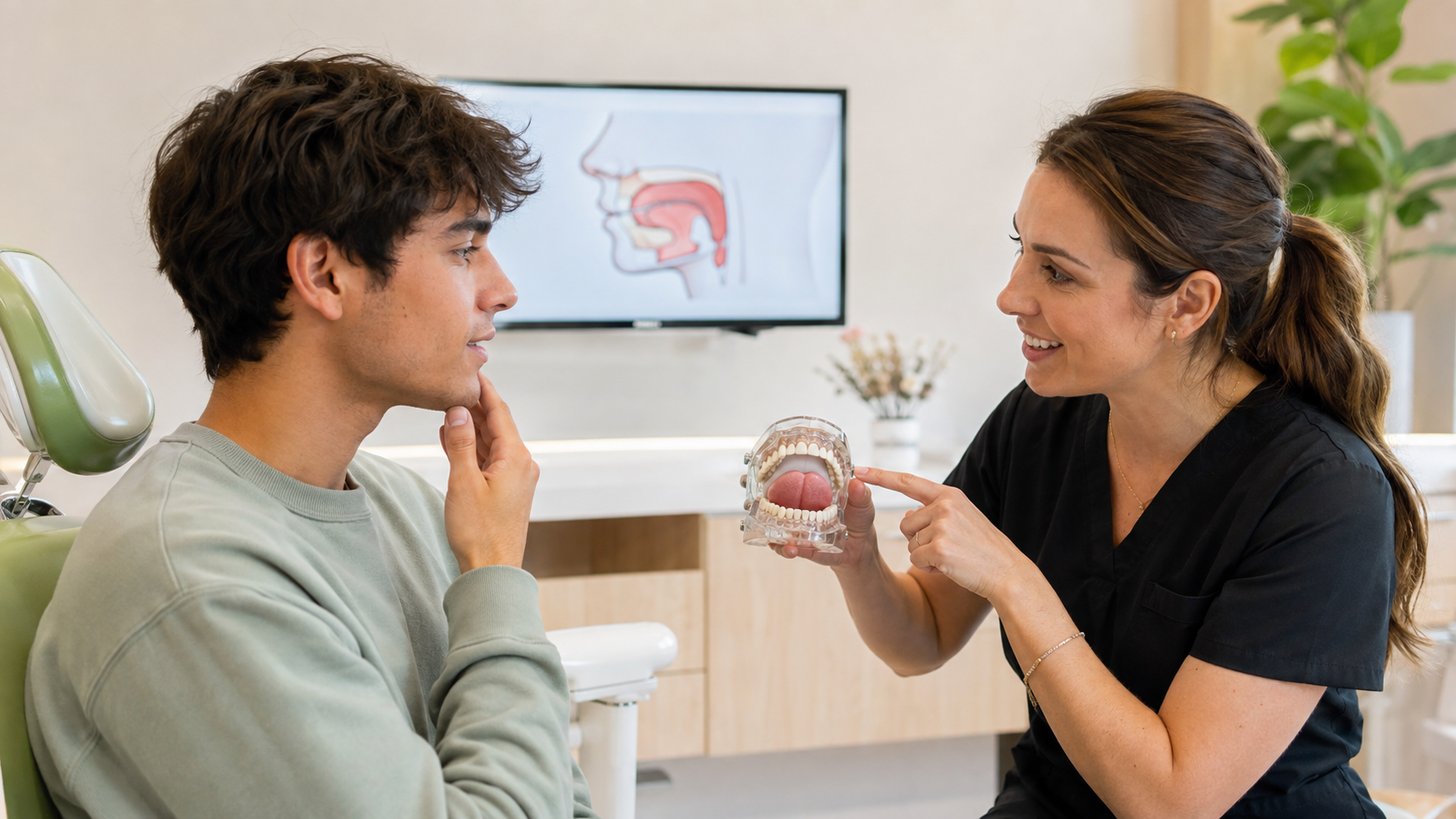
Mewing is a form of oral posture training named after British orthodontist John Mew. The technique involves resting the tongue flat against the roof of the mouth (the palate), keeping the lips closed and teeth lightly together, and breathing through the nose. The claim made online is that sustained pressure from the tongue gradually reshapes the upper jaw and sharpens the jawline over time.
The practice went viral because the promise is irresistible: a free, non-surgical way to change your face, requiring nothing but consistency. That’s also exactly why it deserves a careful look rather than a quick yes or no.
Does Mewing Work? What the Evidence Says
Here’s where we have to be straight with you: there is no credible scientific research demonstrating that mewing reshapes the facial bones of adults. The American Association of Orthodontists has publicly addressed the trend, and the underlying practice of orthotropics has never been validated in peer-reviewed studies at the level its claims would require.
That doesn’t mean nothing happens when you mew. Several things people do notice are real, just not what’s being advertised:
- Improved posture. Holding your tongue up and chin level naturally corrects forward head posture, which visibly changes how your jawline photographs.
- More nasal breathing. Mewing encourages closed-mouth, nose breathing — a genuinely positive habit for oral health.
- Increased muscle awareness. Becoming conscious of where your tongue rests can, over time, change a long-standing habit.
Real changes — just not bone remodelling.
Why Do Mewing Before-and-After Photos Look So Convincing?
Most dramatic mewing before-and-after comparisons involve variables that have nothing to do with tongue posture: different camera angles, different lighting, chin tilt, a slimmer face from weight loss, or simply the ordinary facial maturation that happens through the teens and early twenties anyway. Add a few months between photos and normal growth alone can account for much of the difference.
This isn’t to say people are being dishonest. It’s that “I changed my tongue posture and my face changed” is very easy to believe when both things happened in the same period.
Is Mewing Safe? What to Watch For
For most people, resting the tongue on the palate is harmless — it’s actually close to where the tongue is meant to sit at rest. The risk comes from the more aggressive interpretations circulating online.
Be cautious if you’re:
- Pushing hard against your teeth. Sustained force against teeth can contribute to unwanted tooth movement — the opposite of what people are hoping for.
- Clenching your jaw to hold the position. This can aggravate jaw joint (TMJ) pain and lead to tooth wear.
- Using “hard mewing” or chewing devices. Aggressive jaw-training gadgets sold alongside the trend carry a genuine risk of joint strain.
- Ignoring an underlying problem. If you’re mouth-breathing because your nose is blocked, or you snore, mewing isn’t the fix — and the underlying issue is worth investigating properly.
That last point matters more than most people realise. Chronic mouth breathing and disrupted sleep breathing are things we assess clinically, and they’re covered in more detail on our snoring and sleep apnoea page.
The Legitimate Version: Myofunctional Therapy
Here’s the part that rarely makes it into the viral videos. The core premise behind mewing — that tongue posture, breathing pattern and swallowing mechanics affect oral development — is recognised in dentistry. It just has a different name, a proper assessment process, and far more modest claims.
Myofunctional therapy is a structured, professionally supervised programme that retrains oral rest posture, swallowing patterns and nasal breathing. It’s used to support issues like tongue thrust, mouth breathing and certain bite problems — usually alongside other treatment, not as a magic standalone fix. You can read more about how it works in our guide to how myofunctional therapy can enhance your wellbeing.
The key difference is assessment. A clinician can tell you whether your tongue posture is actually contributing to a problem, or whether the thing bothering you about your jawline is a skeletal or dental alignment issue that posture won’t touch.
What Actually Changes a Jawline or Bite?
If your goal is genuine change to how your teeth or jaw sit, the honest options are:
- Orthodontic treatment — moving teeth into better alignment with braces or aligners. This is well-evidenced and predictable. Our overview of what orthodontists do and when to see one is a good starting point if you’re unsure whether it applies to you.
- Early intervention in children — growth can genuinely be guided while the bones are still developing, which is why habits like mouth breathing are worth addressing early rather than at 25.
- Addressing the airway — if nasal obstruction is forcing mouth breathing, ENT input may matter more than any oral exercise.
- Surgical options — for significant skeletal discrepancies, though this is a serious decision and far beyond the scope of a social media trend.
Frequently Asked Questions
Q: Does mewing work for adults? A: There’s no credible evidence that mewing reshapes adult facial bones. Adult facial structure is largely set, and the visible changes people report are typically explained by posture, camera angle, weight change or normal maturation. Improving your resting tongue posture and nasal breathing is still worthwhile for oral health reasons — just not as a jawline treatment.
Q: How long does mewing take to show results? A: Online claims range from a few months to several years, but since the underlying mechanism isn’t supported by evidence in adults, there’s no meaningful timeframe to give. If you’ve been mewing for months and are frustrated by the lack of change, that’s worth taking as information rather than a reason to push harder.
Q: Is mewing safe for teenagers? A: Resting the tongue gently on the palate is generally harmless at any age. The concern with teenagers is that this is exactly the age where a genuine bite or growth issue is most treatable — so if there’s a real concern about jaw development, a proper orthodontic assessment during those years is far more valuable than a social media technique.
Q: Can mewing fix an overbite or crooked teeth? A: No. Bite problems and crowding are structural, and correcting them requires controlled, measured force applied by orthodontic treatment. Pushing your tongue against your teeth to try to move them can actually cause unwanted movement rather than fixing existing issues.
The Bottom Line
Does mewing work? Not in the way TikTok promises — there’s no credible evidence it reshapes adult facial bones, and the striking before-and-afters are usually explained by other factors. But the instinct behind it isn’t silly. Where your tongue rests, whether you breathe through your nose, and how you swallow genuinely do matter to your oral health, and there’s a properly supervised version of that idea available.
If you’re curious whether your tongue posture or breathing is affecting your teeth — or you’d simply like an honest answer about what could realistically change your bite — that’s a conversation worth having with a clinician rather than a comments section. You can browse more guides like this on our dental blog, or book a consultation with My Smile Doctors in Parramatta.
Written by My Smile Doctors, Parramatta Dental Clinic